Data Mesh Fails on Institutions, Not Technology
- data-mesh
- architecture
- governance
Across enterprise engagements, the pattern is starting to feel like déjà vu. Data mesh is the latest poster child: almost every major organization is now all-in on decentralized data architectures, and to be fair, the core philosophy isn’t flawed. But elegant ideas are one thing and execution is another. Where the rubber meets the road is where value actually lives, and unfortunately, it’s also where data meshes reliably crash and burn.
The failure is almost never technical. It starts when domain ownership is quietly abdicated: the org chart says a business unit owns a data product, but no one on that team actually feels accountable for it. From there the dominoes fall. Data products decay into ill-conceived shadows of their design, federated governance hardens into red tape by another name, and the data catalog becomes an expensive piece of shelfware no one opens. But this collapse isn’t inevitable, nor is it unique to data. Data meshes fail because they get treated as tech stacks rather than shared resources — what political economists call commons. And commons have both a well-documented failure mode and a proven set of rules for keeping them alive.
The commons, not the code
So stop looking at the software architecture for a moment. Look at resource economics instead. A data mesh is a shared resource, plain and simple: data products any domain can consume, but that specific teams have to sweat to maintain. Garrett Hardin’s tragedy of the commons says that when a resource is open to all and owned by none, it degrades. Every time. Everyone wants to query the curated customer master dataset. Nobody wants the 2 AM page when its ingestion pipeline breaks. Strip out the institution that forces investment and polices abuse, and the mesh behaves like an overgrazed pasture — consumption outruns contribution, and trust in the data quietly bleeds out.
Here is the part most people miss: the tragedy is not a law of nature. Elinor Ostrom won a Nobel for proving it. She showed, with decades of field evidence, that self-governed commons can last for centuries with no central authority dictating terms — if certain conditions hold. She catalogued those conditions. And read them now, with a mesh in mind, and it stops looking like she was writing about fisheries and grazing land. She was describing the institution a federated data architecture needs to survive. Meshes don’t fail because the idea is broken. They fail because organizations ship the platform and never build the institution.
Where it actually breaks
You don’t need a degree in institutional economics to spot this — the anti-patterns are in your Slack channels right now. Ostrom’s first rule is clear boundaries, which in a mesh means unambiguous domain ownership. I have watched teams announce “domain ownership” while a central data engineering group quietly kept veto power over every change. That is nominal authority, and it breaks her rule about a recognized right to organize. Her collective-choice arrangements map onto the federated governance guild — the forum where the people affected by the rules get to write them. Too often that guild is a rubber stamp with no teeth. When these conditions are absent, ownership is a job title with no job attached, and the mesh slides back into the centralized mess it was supposed to replace.
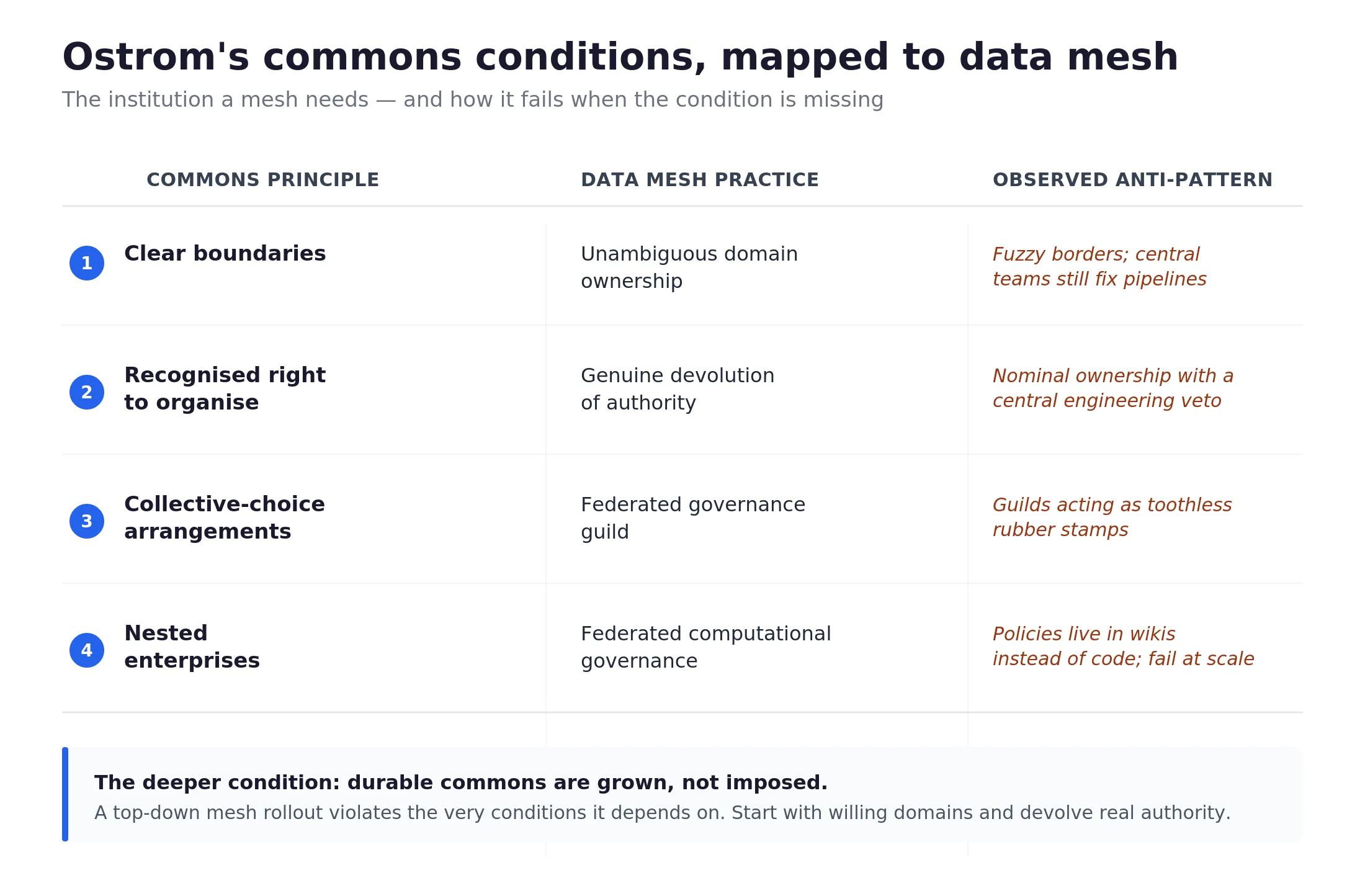
Four of Ostrom’s eight principles, mapped to the mesh practice they demand — and the failure that shows up when the practice is only nominal.
Her hardest lesson for anyone running a transformation programme is this one: durable commons are grown, not imposed. You cannot mandate a living ecosystem into existence from a slide deck. Which makes an enterprise-wide “data mesh transformation programme,” run by a PMO, close to a contradiction in terms. Forcing universal adoption breaks the exact conditions the mesh runs on — it hard-codes the rules, keeps the authority central, and crushes the polycentric structure that lets domains actually adapt. Roll a mesh out by executive fiat and hand out ownership on an org chart, and you haven’t built a decentralized institution. You’ve just spread the blame around more evenly. The platform is live; the institution was dead on arrival.
The go/no-go for a mesh isn’t whether your platform team can provision infrastructure. It’s whether your domains will pick up the phone at 2 AM.
The question to ask before you buy anything
This changes how you decide you’re ready. The first gate is definitional: can you actually draw the boundaries? If nobody can say cleanly who owns the core operational data, stop — everything downstream is built on sand. The second gate is the hard one, and it’s behavioural. Will the domain accept the responsibility that comes with the title? Dodging accountability is human nature, and a mesh only holds when a team says, and means, “this is our data product, we own its quality, full stop.” In my experience the moment that tells you a mesh will work isn’t a clean deployment. It’s the day a domain lead sees a broken pipeline, pulls their team off feature work for the sprint, and fixes the data product — before anyone from a central team asks them to. If your domains won’t carry that weight, you are not ready. No platform closes that gap.
If you’re already mid-flight
Most readers aren’t at the starting line — they’re already airborne and watching the mesh wobble. You can’t mandate your way out of that. Start where the responsibility gap is widest, and go narrow. Drop the talk of universal adoption and maturity scores. Pick the two or three data products that genuinely matter and re-establish ownership on those, with named people who take the role willingly. Grow it, don’t impose it: begin with the domains that want it, make their wins loud and visible, and let the rest opt in when they see it working. In parallel, give your guild real power to change policy, so governance stops being a bottleneck everyone routes around. Every turnaround I’ve seen started the same unglamorous way — pausing the enterprise rollout and fixing the ownership contract in one struggling domain.
There are caveats, and they’re worth being honest about. “Almost never” is carrying weight in that opening line: bad tooling can sink a mesh on its own if publishing data is painful enough that nobody bothers. And Ostrom studied tight local groups where a disapproving look was enough to keep people in line. Enterprise scale erodes that social pressure, which is precisely why you need federated computational governance — code doing the enforcement that trust used to. But the root cause is still institutional. The leaders who make data mesh work are not the ones who bought the best platform. They’re the ones who designed the institution on purpose and made sure their domains owned it first. So before you sign the contract or announce the programme, answer the only question that decides it: will our domains actually own their data? If the answer is no, that is the work. Not the platform.